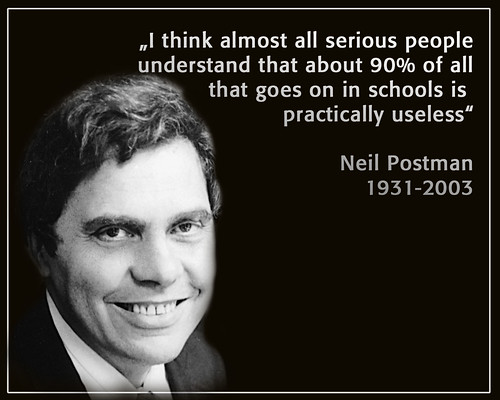
"Every teacher should begin every course making a little speech to the students, that would go along these lines: Hey look I am a fallible human being so during the duration of this course I am bound to make lots of mistakes. I will say things that are untrue. I will give opinions that are unfounded.Your job as a student is to pay a lot of attention and try to identify when I made a mistake. And then try to show me and your classmates where I made that mistake."
Neil Postman
"Textbooks present facts and information...and teach kids that subjects are boring, when in fact they are not."
Neil Postman
These quotes make me happy and put his books on the top of my reading list. :)
And here are the most important parts about him in:
Chandler, D. (2002). Technological determinism. Web essay, Media and Communications Studies, University of Aberystwythhttps://spark-public.s3.
Technological Autonomy Page 02
'The Frankenstein Syndrome: One creates a machine
for a particular and limited purpose. But once the machine is built, we
discover, always to our surprise - that it has ideas of its own; that it is quite
capable not only of changing our habits but... of changing our habits of mind'
(Postman 1983, p. 23). Although Postman denies that that 'the effects of
technology' are always inevitable, he insists that they are 'always
unpredictable' (Postman 1983, p. 24).
Technological Neutrality Page 02
Abraham Maslow, the psychologist, once said that to someone who has only a hammer,
the whole world looks like a nail. And Neil Postman adds that 'to a man with a pencil,
everything looks like a list. To a man with a camera, everything looks like an
image. To a man with a computer, everything looks like data' (Postman 1993,
p. 14).
He argues that:
(1) because of the symbolic forms in which information is encoded,
different media have different intellectual and emotional biases;
(2) because of the accessibility and speed of their information, different
media have different political biases;
(3) because of their physical form, different media have different
sensory biases;
(4) because of the conditions in which we attend to them, different
media have different social biases;
(5) because of their technical and economic structure, different media
have different content biases.
(Postman 1979, p. 193)
Postman insists that 'the printing press, the computer, and television are not
therefore simply machines which convey information. They are metaphors
through which we conceptualize reality in one way or another. They will
classify the world for us, sequence it, frame it, enlarge it, reduce it, argue a
case for what it is like. Through these media metaphors, we do not see the
world as it is. We see it as our coding systems are. Such is the power of the
form of information' (Postman 1979, p. 39).
Postman, Neil (1979): Teaching as a Conserving Activity. New York:
Dell
Postman, Neil (1983): The Disappearance of Childhood. London: W H
Allen
Postman, Neil (1993): Technopoly: The Surrender of Culture to
Technology. New York: Vintage
Here is another article:
Postman, Neil. THE END OF EDUCATION: Redefining the Value of School . Knopf, New York,. 2013-01-29. URL:http://www.ucs.mun.ca/~
And you can find more great articles and links on http://neilpostman.org/

Text by Céline Keller is licensed under a Creative Commons Attribution-ShareAlike 3.0 Unported License. Files, Pictures and Videos might not be.
#edcmooc #articles #talks #videos #NeilPostman #TechnologicalDeterminism
And here are the most important parts about him in:
Chandler, D. (2002). Technological determinism. Web essay, Media and Communications Studies, University of Aberystwythhttps://spark-public.s3.
Technological Autonomy Page 02'The Frankenstein Syndrome: One creates a machine
for a particular and limited purpose. But once the machine is built, we
discover, always to our surprise - that it has ideas of its own; that it is quite
capable not only of changing our habits but... of changing our habits of mind'
(Postman 1983, p. 23). Although Postman denies that that 'the effects of
technology' are always inevitable, he insists that they are 'always
unpredictable' (Postman 1983, p. 24).
Technological Neutrality Page 02
Abraham Maslow, the psychologist, once said that to someone who has only a hammer,
the whole world looks like a nail. And Neil Postman adds that 'to a man with a pencil,
everything looks like a list. To a man with a camera, everything looks like an
image. To a man with a computer, everything looks like data' (Postman 1993,
p. 14).
He argues that:
(1) because of the symbolic forms in which information is encoded,
different media have different intellectual and emotional biases;
(2) because of the accessibility and speed of their information, different
media have different political biases;
(3) because of their physical form, different media have different
sensory biases;
(4) because of the conditions in which we attend to them, different
media have different social biases;
(5) because of their technical and economic structure, different media
have different content biases.
(Postman 1979, p. 193)
Postman insists that 'the printing press, the computer, and television are not
therefore simply machines which convey information. They are metaphors
through which we conceptualize reality in one way or another. They will
classify the world for us, sequence it, frame it, enlarge it, reduce it, argue a
case for what it is like. Through these media metaphors, we do not see the
world as it is. We see it as our coding systems are. Such is the power of the
form of information' (Postman 1979, p. 39).
Postman, Neil (1979): Teaching as a Conserving Activity. New York:
Dell
Postman, Neil (1983): The Disappearance of Childhood. London: W H
Allen
Postman, Neil (1993): Technopoly: The Surrender of Culture to
Technology. New York: Vintage
Here is another article:
Postman, Neil. THE END OF EDUCATION: Redefining the Value of School . Knopf, New York,. 2013-01-29. URL:http://www.ucs.mun.ca/~
And you can find more great articles and links on http://neilpostman.org/
Text by Céline Keller is licensed under a Creative Commons Attribution-ShareAlike 3.0 Unported License. Files, Pictures and Videos might not be.
#edcmooc #articles #talks #videos #NeilPostman #TechnologicalDeterminism
