For my final assignment I resurrected and finished an old project, which sadly had been parked on my unfinished projects graveyard. I am happy to finally give it a life!
For me it represents my thoughts about technology, learning and the future. I think technology drives history and social change, but still we decide the ultimate direction. We are not helpless and technology is not pressured on us by an "alien" force, because without us there wouldn't be technology in the first place. It's important to encourage a lively public discussion about what all these innovations mean for humanity in a very large and wide context. Only through this public discussion will we be able to decide which unwanted consequences we are prepared to pay and which not. Science and technology can be incredible useful for humanity, but all the controversies of today also remind me of a poem by Goethe called:
You canread The Sorcerer's Apprentice, as well as other all encompassing technologies like genetics or an internet that destroys every safe place for our privacy, in two ways:
First:
Some things are too powerful to mess with, if you don't have mastery about them - meaning having thought about all the consequences and what to do about them.
And Second:
Lying can be seen as willingly obscuring half of of the truth, but if you call this magical power you can never be sure or get rid of the consequences. (which reminds me of metaphors and how science and advertisement often encourage one sided ways to think about certain topics)
I think technology can solve a lot of humanities problems, but we have to stop closing our eyes for the not so beautiful consequences. Only if we can ponder and discuss the whole big picture, we can over come our fears, find solutions and work in the right direction. Utopia for me still is the right direction, but to pursue it we have to dream consciously, knowing about the problems we need to solve, which is actually quite hard work and not easy at all.
Please press the HD button and head over to vimeo to see the video in High Definition!
It was very interesting to think about our word choices and the consequences they entail.
I loved this part of the paper most:
"When individuals chose the metaphors they used to describe the Internet, they also selected a filter for viewing the Internet. This result makes it vital for us to reflect on our metaphors and select them with care. In these example editorials, the most–used metaphors surrounded ideas of destruction. If theInternet is destruction metaphor becomes the predominant schema for reflecting on online experiences, how might this impact the future of the Internet? Could this metaphor encourage censorship and oppression online? What other metaphors better convey the future and potential of the Internet?"
It reminded me of an Alan Moore quote that touched me. The quote is about what it means to be an artist, but I think it fits to what Johnston is writing about:
"There is some confusion as to what magic actually is. I think this can be cleared up if you just look
at the very earliest descriptions of magic. Magic in its earliest form is often referred to as “the art”.
I believe this is completely literal. I believe that magic is art and that art, whether it be writing, music, sculpture, or any other form is literally magic. Art is, like magic, the science of manipulating symbols, words, or images, to achieve changes in consciousness. The very language about magic seems to be talking as much about writing or art as it is about supernatural events.
A grimmoir for example, the book of spells is simply a fancy way of saying grammar. Indeed, to cast a spell, is simply to spell, to manipulate words, to change people's consciousness.
And I believe that this is why an artist or writer is the closest thing in the contemporary world that you are likely to see to a Shaman. I believe that all culture must have arisen from cult. Originally, all of the faucets of our culture, whether they be in the arts or sciences were the province of the Shaman. The fact that in present times, this magical power has degenerated to the level of cheap entertainment and manipulation, is, I think a tragedy. At the moment the people who are using Shamanism and magic to shape our culture are advertisers. Rather than try to wake people up, their Shamanism is used as an opiate to tranquilize people, to make people more manipulable. Their magic box of television, and by their magic words, their jingles can cause everyone in the country to be thinking the same words and have the same banal thoughts all at exactly the same moment.
In all of magic there is an incredibly large linguistic component.
The Bardic tradition of magic would place a bard as being much higher and more fearsome than a magician. A magician might curse you. That might make your hands lay funny or you might have a child born with a club foot. If a Bard were to place not a curse upon you, but a satire, then that could destroy you. If it was a clever satire, it might not just destroy you in the eyes of your associates;
it would destroy you in the eyes of your family. It would destroy you in your own eyes.
And if it was a finely worded and clever satire that might survive and be remembered for decades, even centuries. Then years after you were dead people still might be reading it and laughing at you
and your wretchedness and your absurdity. Writers and people who had command of words were respected and feared as people who manipulated magic. In latter times I think that artists and writers have allowed themselves to be sold down the river. They have accepted the prevailing belief that art and writing are merely forms of entertainment. They’re not seen as transformative forces that can change a human being; that can change a society. They are seen as simple entertainment; things with which we can fill 20 minutes, half an hour, while we’re waiting to die. It’s not the job of the artist to give the audience what the audience wants.
If the audience knew what they needed, then they wouldn’t be the audience.
They would be the artists. It is the job of artists to give the audience what they need."
-Alan Moore
The quote is taken from the documentary: The Mindscape of Alan Moore
"Most people prefer to walk backwards into the future. It's a posture that is maybe uncomfortable, but at least it allows us to look at familiar things as long as possible. Now what happens when you do that of course is you get hit by the truck of change."
Marc Prensky
"A lot of our kids say they come to school and they say when I come into the building I have to power down. They don't mean that devices. They mean their brains. Thy mean they get to do more powerful stuff outside of school than they do inside of school." Marc Prensky "Do our kid's have attention deficit disorder? A lot of people think so giving them ritalin and other drugs. Here is what the kids say: It's not attention deficit disorder, we are just not listening. - Engage me or enrage me -"
Marc Prensky
This is a fantastic talk by Marc Prensky held at the Global Education Forum 2010
( Sadly there are a couple of short periods when he shows his presentation where you
can not hear the audio but I didn't mind. It is not that important to understand the talk. )
"Sparking extensive debate, while working its way into common usage, Prensky’s metaphor of the native and the immigrant is one of the best-known accounts of the effects of the digital upon education. Offering a narrative of ‘native’ young people’s seamless integration with technology, and the revolutionary changes that information technology has brought, Prensky warns ‘immigrant’ teachers that they face irrelevance unless they figure out how to adapt their methods and approaches to new generations of learners. When reading this paper, try to identify the strategies that Prensky uses to make his argument - how does the language he uses work to persuade the reader? Who are ‘we’ and who are ‘they’? What associations do you have with the idea of the ‘native’ and the ‘immigrant’, and how helpful are these in understanding teacher-student relationships?"
I think he nailed it, in the sense that as an 'immigrant' it is hard to understand a different language.
Not because you don't understand the words but because of the subtle cultural differences expressed between the lines. Some things you just don't get. ( I spent some years in Argentina and I think it took me 3 years a until I started to understand what and how big the differences really are).
This 'we' and 'they" or 'immigrants' and natives' also expresses a common hostility that grows in these situations. For example: First I found it annoying that people always seemed to talked on top of each other. My frustration made me misunderstand the cultural circumstances. I had to be open and not assume this to be an impolite gesture to realize the beauty of the argentinian way of social gatherings.
Acknowledging my own limitations and the resulting frustration was necessary too. :)
+Britt Watwood shared this great article:
From digital immigrants and digital natives to digital wisdom
"Digital wisdom transcends the generational divide defined by the immigrant/native distinction. Many digital immigrants exhibit digital wisdom.
...
The point is that while the need for wise people to discuss, define, compare, and evaluate perspectives is not changing, the means by which they do so and the quality of their efforts are growing more sophisticated because of digital technology. As a result, the unenhanced brain is well on its way to becoming insufficient for truly wise decision making. When we are all enhanced by implanted lie detectors, logic evaluators, and executive function and memory enhancements—all of which will likely arrive in our children's lifetimes—whoamong us will be considered wise? The advantage will go, almost certainly, to those who intelligently combine their innate capacities with their digital enhancements."
"So what constitutes digital wisdom? What habits do the digitally wise use to advance their capabilities and the capabilities of those around them? Can digital wisdom be taught?" "Digital wisdom can be, and must be, learned and taught. As we offer more courses in digital literacy, we should also offer students guidance in developing digital wisdom. Parents and educators are digitally wise when they recognize this imperative and prepare the children in their care for the future—educators by letting students learn by using new technologies, putting themselves in the role of guides, context providers, and quality controllers, and parents by recognizing the extent to which the future will be mediated by technology and encouraging their children to use digital technology wisely."
"The digitally wise also realize that the ability to control digital technology, to bend it to their needs, is a key skill in the digital age. As a result, they are interested in programming, in the broadest sense of the word, that is, in making machines do what people want them to do."
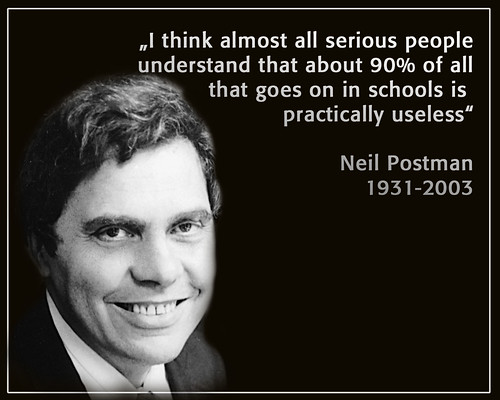
"Every teacher should begin every course making a little speech to the students, that would go along these lines: Hey look I am a fallible human being so during the duration of this course I am bound to make lots of mistakes. I will say things that are untrue. I will give opinions that are unfounded.Your job as a student is to pay a lot of attention and try to identify when I made a mistake. And then try to show me and your classmates where I made that mistake."
Neil Postman
"Textbooks present facts and information...and teach kids that subjects are boring, when in fact they are not."
Neil Postman
These quotes make me happy and put his books on the top of my reading list. :)
And here are the most important parts about him in:
Technological Autonomy Page 02
'The Frankenstein Syndrome: One creates a machine for a particular and limited purpose. But once the machine is built, we discover, always to our surprise - that it has ideas of its own; that it is quite capable not only of changing our habits but... of changing our habits of mind'
(Postman 1983, p. 23). Although Postman denies that that 'the effects of
technology' are always inevitable, he insists that they are 'always
unpredictable' (Postman 1983, p. 24).
Technological Neutrality Page 02
Abraham Maslow, the psychologist, once said that to someone who has only a hammer, the whole world looks like a nail. And Neil Postman adds that 'to a man with a pencil, everything looks like a list. To a man with a camera, everything looks like an image. To a man with a computer, everything looks like data' (Postman 1993,
p. 14).
He argues that:
(1) because of the symbolic forms in which information is encoded,
different media have different intellectual and emotional biases;
(2) because of the accessibility and speed of their information, different
media have different political biases;
(3) because of their physical form, different media have different
sensory biases;
(4) because of the conditions in which we attend to them, different
media have different social biases;
(5) because of their technical and economic structure, different media
have different content biases.
(Postman 1979, p. 193)
Postman insists that 'the printing press, the computer, and television are not therefore simply machines which convey information. They are metaphors through which we conceptualize reality in one way or another. They will
classify the world for us, sequence it, frame it, enlarge it, reduce it, argue a
case for what it is like. Through these media metaphors, we do not see the
world as it is. We see it as our coding systems are. Such is the power of the
form of information' (Postman 1979, p. 39).
Postman, Neil (1979): Teaching as a Conserving Activity. New York:
Dell
Postman, Neil (1983): The Disappearance of Childhood. London: W H
Allen
Postman, Neil (1993): Technopoly: The Surrender of Culture to
Technology. New York: Vintage Here is another article: Postman, Neil. THE END OF EDUCATION: Redefining the Value of School . Knopf, New York,. 2013-01-29. URL:http://www.ucs.mun.ca/~emurphy/stemnet/postman.html. Accessed: 2013-01-29. (Archived by WebCite® at http://www.webcitation.org/6E2aK64QY)
And you can find more great articles and links on http://neilpostman.org/
When I did my first MOOC 'Fantasy and Science Fiction: The Human Mind, Our Modern World'
I was very frustrated and angry about the fact that after the course ended, they took down everything: the whole forums and the wiki page including all the information and links we students collected.
It doesn't make any sense to me and to be honest I find it offensive. The only reason I could think of was coursera trying to create a 'business model'. That's another reason why you should set up
your own blog and save the information that is valuable for you.
Or as my friend Marcio Gualtieri put it:
"You can't change the world (in a positive way) and have a "business model". I hope that MOOCs
read this book, because from my interaction with them I have the impression that they just don't get it."
I love the quote Salman Khan puts in the beginning of his book:
Don't limit a child to your own learning, for he was born in another time. - Rabindranatha Tagore
You can read the Introduction to his new book here:
"Education scientist Sugata Mitra tackles one of the greatest problems of education -- the best teachers and schools don't exist where they're needed most. In a series of real-life experiments from New Delhi to South Africa to Italy, he gave kids self-supervised access to the web and saw results that could revolutionize how we think about teaching." http://www.hole-in-the-wall.com/
Another beautiful and more recent project by 'One Laptop per Child' in the same spirit:
Given Tablets but No Teachers, Ethiopian Children Teach Themselves
"Earlier this year, OLPC workers dropped off closed boxes containing the tablets, taped shut, with no instruction. “I thought the kids would play with the boxes. Within four minutes, one kid not only opened the box, found the on-off switch … powered it up. Within five days, they were using 47 apps per child, per day. Within two weeks, they were singing ABC songs in the village, and within five months, they had hacked Android,” Negroponte said. “Some idiot in our organization or in the Media Lab had disabled the camera, and they figured out the camera, and had hacked Android.” http://www.technologyreview.com/news/506466/given-tablets-but-no-teachers-ethiopian-children-teach-themselves/
I enjoyed reading this speech very much and in my opinion it is as relevant as it was 10 years ago.
My favorite part was the one about the donkeys:
"Another example of the need for broad thinking about technology comes from Latin America.
How do you get children to school in a rural, mountainous region when they live a good way away
and you don't want them to arrive at school already tired out? The answer was that you get hold of some donkeys. The problem is that it is difficult to buy donkeys under the United Nations procurement guidelines. These guidelines require performance specifications, tendering and suchlike.
The solution is to hire the donkeys as consultants, which is fine under the UN rules. Donkeys also have one great advantage compared to human consultants - they do not write reports."
I highly recommend to take 90 minutes and listen. I believe what happened to Aaron and what he fought for is at the heart of the learning revolution. RT@timoreilly The text of @carlmalamud's passionate defense of Aaron Swartz: https://public.resource.org/aaron/army/ "I see the army of Mahatma Gandhi walking peacefully to the sea to make salt for the people. I see the army of Martin Luther King walking peacefully but with determination to Washington to demand their rights because change does not roll in on the wheels of inevitability, it comes through continuous struggle."