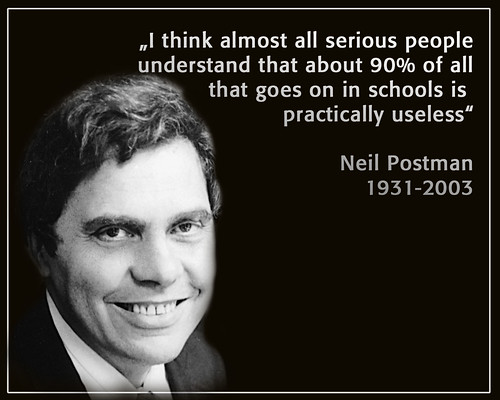
"Most people prefer to walk backwards into the future. It's a posture that is maybe uncomfortable, but at least it allows us to look at familiar things as long as possible.
Now what happens when you do that of course is you get hit by the truck of change."
Marc Prensky
"A lot of our kids say they come to school and they say when I come into the building I have to power down. They don't mean that devices. They mean their brains. Thy mean they get to do more powerful stuff outside of school than they do inside of school."
Marc Prensky
"Do our kid's have attention deficit disorder? A lot of people think so giving them ritalin and other drugs. Here is what the kids say: It's not attention deficit disorder, we are just not listening. - Engage me or enrage me -"
Marc Prensky
This is a fantastic talk by Marc Prensky held at the
Global Education Forum 2010
( Sadly there are a couple of short periods when he shows his presentation where you
can not hear the audio but I didn't mind. It is not that important to understand the talk. )
Marc seems to post all his essays and articles online. You can find them here:
http://www.marcprensky.com/writing/
That's how I like it!
He also has a nice collection of all the videos about him posted on his webpage:
http://www.marcprensky.com/videos/
Don't forget to follow him on twitter:
@marcprensky
From the #edcmooc wiki page:
Digital Natives, Digital Immigrants. Prensky, M. (2001).
http://www.marcprensky.com/writing/prensky%20-%20digital%20natives,%20digital%20immigrants%20-%20part1.pdf
"Sparking extensive debate, while working its way into common usage, Prensky’s metaphor of the native and the immigrant is one of the best-known accounts of the effects of the digital upon education. Offering a narrative of ‘native’ young people’s seamless integration with technology, and the revolutionary changes that information technology has brought, Prensky warns ‘immigrant’ teachers that they face irrelevance unless they figure out how to adapt their methods and approaches to new generations of learners. When reading this paper, try to identify the strategies that Prensky uses to make his argument - how does the language he uses work to persuade the reader? Who are ‘we’ and who are ‘they’? What associations do you have with the idea of the ‘native’ and the ‘immigrant’, and how helpful are these in understanding teacher-student relationships?"
I think he nailed it, in the sense that as an 'immigrant' it is hard to understand a different language.
Not because you don't understand the words but because of the subtle cultural differences expressed between the lines. Some things you just don't get. ( I spent some years in Argentina and I think it took me 3 years a until I started to understand what and how big the differences really are).
This 'we' and 'they" or 'immigrants' and natives' also expresses a common hostility that grows in these situations. For example: First I found it annoying that people always seemed to talked on top of each other. My frustration made me misunderstand the cultural circumstances. I had to be open and not assume this to be an impolite gesture to realize the beauty of the argentinian way of social gatherings.
Acknowledging my own limitations and the resulting frustration was necessary too. :)
+Britt Watwood shared this great article:
From digital immigrants and digital natives to digital wisdom
"Digital wisdom transcends the generational divide defined by the immigrant/native distinction. Many digital immigrants exhibit digital wisdom.
...
The point is that while the need for wise people to discuss, define, compare, and evaluate perspectives is not changing, the means by which they do so and the quality of their efforts are growing more sophisticated because of digital technology. As a result, the unenhanced brain is well on its way to becoming insufficient for truly wise decision making. When we are all enhanced by implanted lie detectors, logic evaluators, and executive function and memory enhancements—all of which will likely arrive in our children's lifetimes—whoamong us will be considered wise? The advantage will go, almost certainly, to those who intelligently combine their innate capacities with their digital enhancements."
"So what constitutes digital wisdom? What habits do the digitally wise use to advance their capabilities and the capabilities of those around them? Can digital wisdom be taught?"
"Digital wisdom can be, and must be, learned and taught. As we offer more courses in digital literacy, we should also offer students guidance in developing digital wisdom. Parents and educators are digitally wise when they recognize this imperative and prepare the children in their care for the future—educators by letting students learn by using new technologies, putting themselves in the role of guides, context providers, and quality controllers, and parents by recognizing the extent to which the future will be mediated by technology and encouraging their children to use digital technology wisely."
"The digitally wise also realize that the ability to control digital technology, to bend it to their needs, is a key skill in the digital age. As a result, they are interested in programming, in the broadest sense of the word, that is, in making machines do what people want them to do."
Marc Prensky
By Marc Prensky [CC-BY-SA-3.0 (http://creativecommons.org/licenses/by-sa/3.0)], via Wikimedia Commons
#edcmooc #MarcPrensky #TechnologicalDeterminism #talks #videos #utopia
 Text
Text by
Céline Keller is licensed under a
Creative Commons Attribution-ShareAlike 3.0 Unported License.
Files, Pictures and Videos might not be.